Complex alloy research · IMR, CAS

From atomic configurations to phase stability.

I develop atomistic, thermodynamic, and machine-learning methods to connect local chemical environments with finite-temperature stability, phase diagrams, defects, and mechanical behavior in compositionally complex materials.

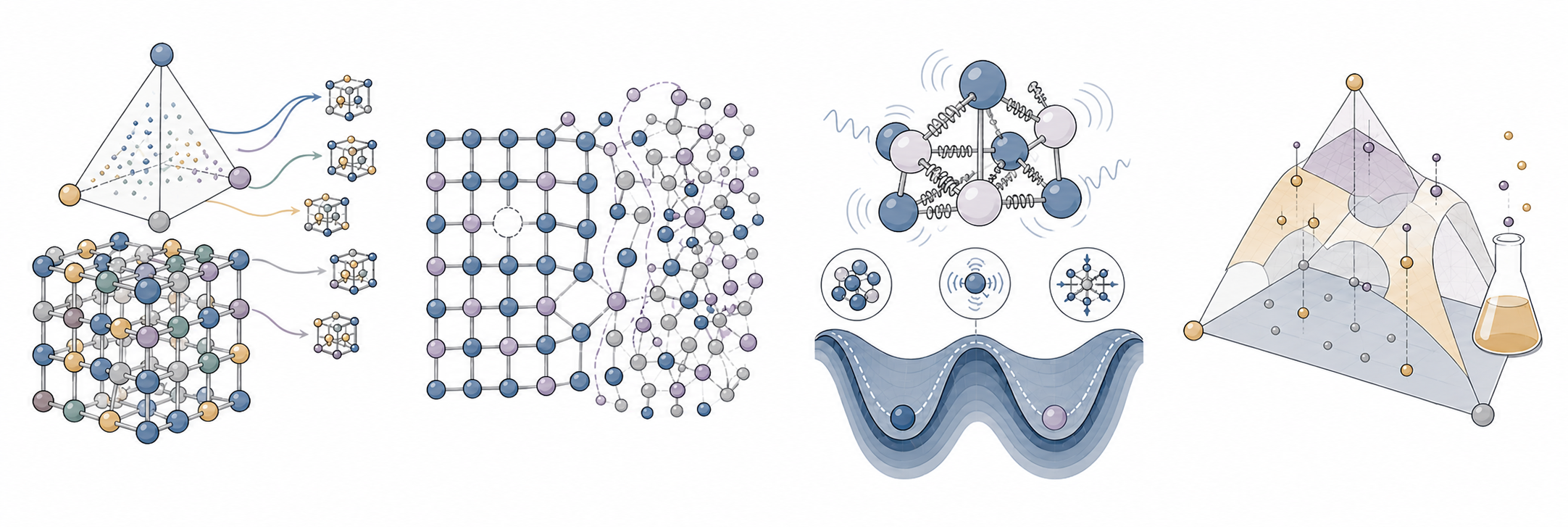
Atomic structures and modeling concepts for complex alloys
Structure representation, statistical sampling, energetics, and thermodynamic modeling.

Core question

How do high-dimensional alloys select structures and phases?

Complex alloys combine vast composition spaces, non-ideal atomic structures, coupled free-energy contributions, and limited experimental data. My work builds transferable descriptions that remain physically grounded while reaching the scales required for materials design.

Atomic structure Energy and sampling Free energy and phase stability Data and experimental feedback

01

Thermodynamics and phase diagrams

Predicting finite-temperature stability from atomic interactions

I combine density functional theory, special quasirandom structures, cluster expansion, Monte Carlo sampling, CALPHAD, and machine-learning interatomic potentials to calculate phase stability across multicomponent alloy spaces.

PhaseForge automates the path from structure generation and energy evaluation to free-energy fitting, mechanical-instability treatment, and phase diagram prediction. PhaseForgePlus incorporates experimental evidence to refine physically constrained thermodynamic models.
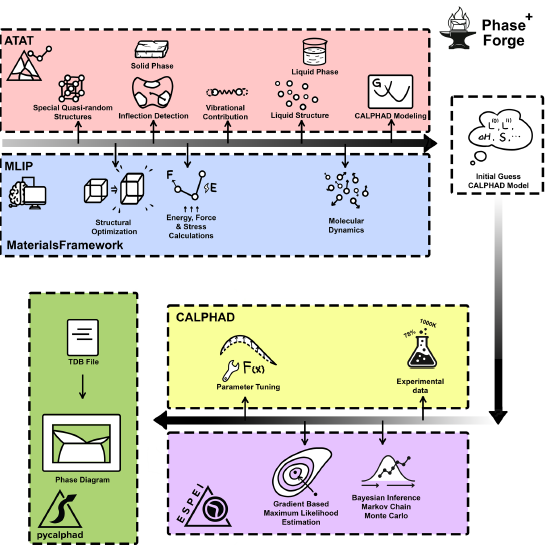
PhaseForge workflow for machine-learning-potential-assisted phase diagram prediction
PhaseForge connects machine-learning potentials with atomistic and CALPHAD workflows.

02

Metallic glasses

Representative amorphous structures and shear localization

Metallic glasses require models that retain realistic short-range geometry without the cost of very large atomistic cells. I introduced Special Glass Structures and developed MAST to optimize compact models against geometric and topological descriptors from larger amorphous systems.

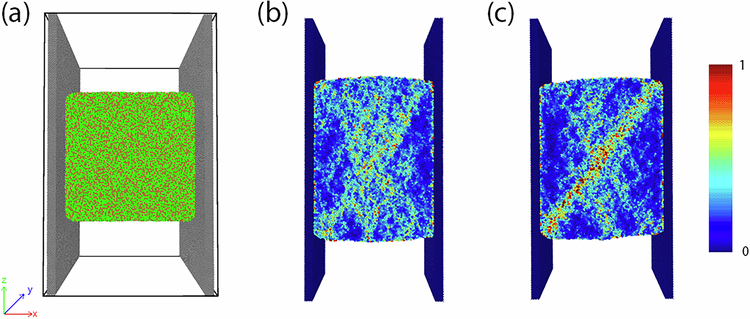
These models enable higher-accuracy calculations and controlled studies of how density fluctuations, local free volume, and cooperative rearrangements contribute to shear-band formation.

Atomistic simulations showing density-fluctuation-induced shear localization in metallic glass
Controlled low-density regions reveal the onset and evolution of shear localization.

03

Defects and interstitials

Searching complex defect environments with Monte Carlo and ML potentials

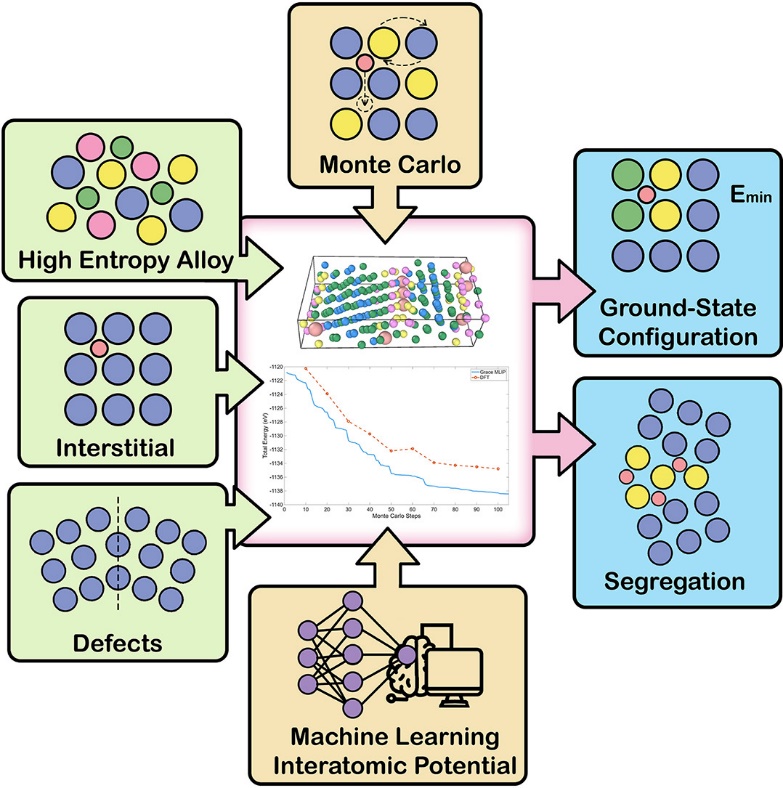
Interstitial solutes, surfaces, grain boundaries, dislocations, and vacancies create enormous configuration spaces in high-entropy and refractory alloys. I study segregation, local chemical environments, and defect stabilization through hierarchical sampling and atomistic relaxation.

PAIPAI combines Monte Carlo exploration with machine-learning-potential optimization and energy evaluation to identify low-energy configurations at both zero and finite temperature.

PAIPAI workflow for sampling interstitial and defect configurations in complex alloys
Hierarchical sampling links candidate structures, local environments, and energetic stability.

Open research infrastructure

Software built around scientific questions

Lead co-developer

PhaseForge

High-throughput alloy phase diagrams and MLIP evaluation.

Collaborative developer

PhaseForgePlus

Physically constrained CALPHAD models refined with experimental data.

Independent developer

MAST

Compact representative structures for amorphous alloys.

Independent developer

PAIPAI

Structure search in complex alloys with interstitials and defects.

Research outlook

From reusable methods to shared materials infrastructure

01

High-dimensional phase diagrams and data

Unify atomistic, thermodynamic, and experimental evidence in standardized high-throughput workflows and reusable alloy databases.

02

Non-ideal structures and AI models

Generate defect-focused datasets, train models for structure and property prediction, and close the loop with experimental validation.